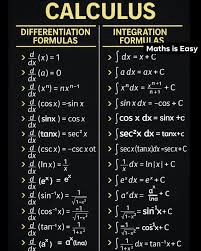
Today’s math lesson was a full-circle return to the foundations of calculus, as we reviewed both differentiation and integration — the two pillars that support almost every advanced topic in mathematics. Even though I’ve learned them before, revisiting them together showed how closely connected they are and how powerful they become when used side by side.
We started with differentiation, refreshing the core rules: power rule, product rule, quotient rule, and the chain rule. But instead of simply applying formulas, the focus was on understanding when and why each rule is used. We practiced identifying structures inside complicated expressions — spotting compositions, hidden products, and places where simplification can make the derivative cleaner. It was less about speed, more about strategy.
Then we transitioned into integration, which always feels like the “reverse” puzzle to differentiation. We reviewed basic integrals, substitution, and recognizing patterns that match derivative rules. What made the lesson interesting was how integration suddenly became easier once the links between the two processes were emphasized. For example, identifying an expression that fits the derivative of a product or chain rule can immediately hint at the right integration method.
A major part of the lesson was solving problems where both operations appear together — such as checking answers by differentiating integrals, or integrating to find displacement after differentiating a velocity function. Problems like these showed how differentiation and integration aren’t separate skills, but rather two tools that solve different sides of the same mathematical story.
We also tackled a set of mixed practice questions that included simplifying before differentiating, integrating functions that look intimidating until you recognize a structure, and applying both techniques to real contexts like motion, area, and growth. These problems were challenging but satisfying, especially when both calculus tools worked together to complete a solution.
Overall, this review felt like reinforcing the backbone of calculus. Differentiation and integration each have their own rules and tricks, but learning how they echo each other — and how one can undo or verify the other — really deepened my understanding. It was a solid, balanced refresher, and it made me feel more prepared for the harder calculus topics ahead.






 Louis La Minh Hoang