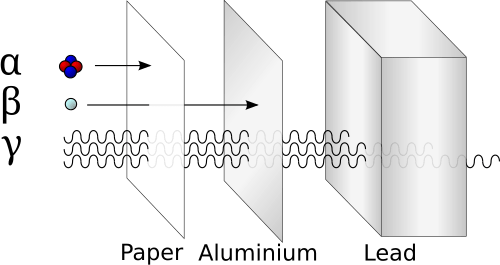
This physics lesson was a focused revision on radiation, but not in a shallow, definition-based way. Instead, it was about reconnecting all the concepts together and understanding how radiation behaves quantitatively and physically in real situations.
We revisited the three main types of radiation — alpha, beta, and gamma — but the emphasis was on comparing them through their properties, not just memorizing facts. We analyzed their ionising power, penetrating ability, and behavior in electric and magnetic fields, and more importantly, why those differences exist based on charge, mass, and energy.
A major part of the revision involved radioactive decay and half-life problems. These weren’t simple plug-in questions. We had to carefully track decay over multiple half-lives, interpret decay graphs, and reason backwards to find original quantities. Understanding the shape of decay curves and what each part of the graph represents was essential.
We also worked on radiation safety and applications, but again at a deeper level. Instead of listing uses, we justified why specific types of radiation are chosen for medical imaging, cancer treatment, smoke detectors, or industrial testing. Shielding wasn’t just “paper stops alpha” — it became a reasoning problem involving energy loss and interaction with matter.
Another challenging aspect was interpreting count-rate graphs and experimental setups. We had to distinguish background radiation from source radiation, analyze measurement errors, and explain fluctuations using statistical reasoning rather than calling them “mistakes.”
By the end of the lesson, this revision tied everything together — the theory, the graphs, the calculations, and the real-world meaning. Radiation stopped feeling like isolated facts and instead became a coherent system governed by probability, energy, and physical laws. Even as a revision lesson, it required careful thinking and strong conceptual understanding, proving that radiation is simple on the surface but deep underneath.




 Louis La Minh Hoang